
-


A Home Depot store in Ontario, Oregon, photographed October 7, 2024. Archival company context, not the November 2026 earnings event. Photo: Rick Obst · CC BY 2.0. Displayed responsively; thumbnails may be cropped. Original photo license is retained. Home Depot reported $43.4 billion in fiscal third-quarter sales. Its 2.2% comparable-sales gain answers a different question from total growth.
Key takeaways
- Fiscal Q3 sales increased 4.9% to $43.4 billion.
- Comparable sales rose 2.2% overall and in the United States.
- Reported diluted EPS was $3.72; adjusted diluted EPS was $3.86.
What the retailer reported
Home Depot’s November 17 release reported fiscal third-quarter sales of $43.4 billion, up 4.9% from a year earlier. Comparable sales rose 2.2%, including a 2.2% increase in the United States. MarketScreener’s independent earnings coverage corroborated those sales and comparable-sales figures.
Two views of growth
Total revenue describes the size of the business’s sales. Comparable sales use a more restricted comparison base defined by the company. The measures can move at different rates without contradicting one another. Treating a 4.9% total increase as a 4.9% increase across the comparable store base would misread the report.
Keep the earnings labels attached
The company reported net earnings of $3.7 billion and diluted earnings per share of $3.72. Its adjusted diluted EPS was $3.86. The adjusted measure is non-GAAP, and the release provides a reconciliation. Neither number should silently replace the other: each has a different accounting scope.
An outlook is still an outlook
Management updated fiscal 2026 guidance to approximately 4.5% total-sales growth and approximately 1.4% comparable-sales growth. Those are company expectations for the full fiscal year, not results already achieved for that period. Later operating conditions can change an outlook.
What readers can examine next
A useful review keeps reported sales, comparable sales, accounting earnings and management guidance on separate lines. Then compare the same measure over the same reporting periods. The release alone does not explain the experience of every store or contractor, and this report does not attribute a share-price movement to any single announcement.
Key terms
Revenue: Income recognized from a business’s activities before subtracting all expenses.
Earnings per share: Profit attributable to each share under the specified calculation; diluted and adjusted measures need their labels.
Continue with the financial glossary and worked market examples.
Sources and reporting dates
Home Depot: fiscal Q3 results — 2026-11-17.
MarketScreener / Finwire: independent results coverage — 2026-11-17.
Original reporting and educational analysis prepared with AI assistance. Sources checked on November 17, 2026. No live share-price reaction is asserted. Educational information, not personalized investment advice.
Educational disclaimer. MR. P MINDSET provides information and education, not personalized investment, financial, trading, legal or tax advice. Nothing here recommends buying, selling or holding a security. Investing and trading involve risk, including loss of capital. Past performance does not guarantee future results.
November 17, 2026 -

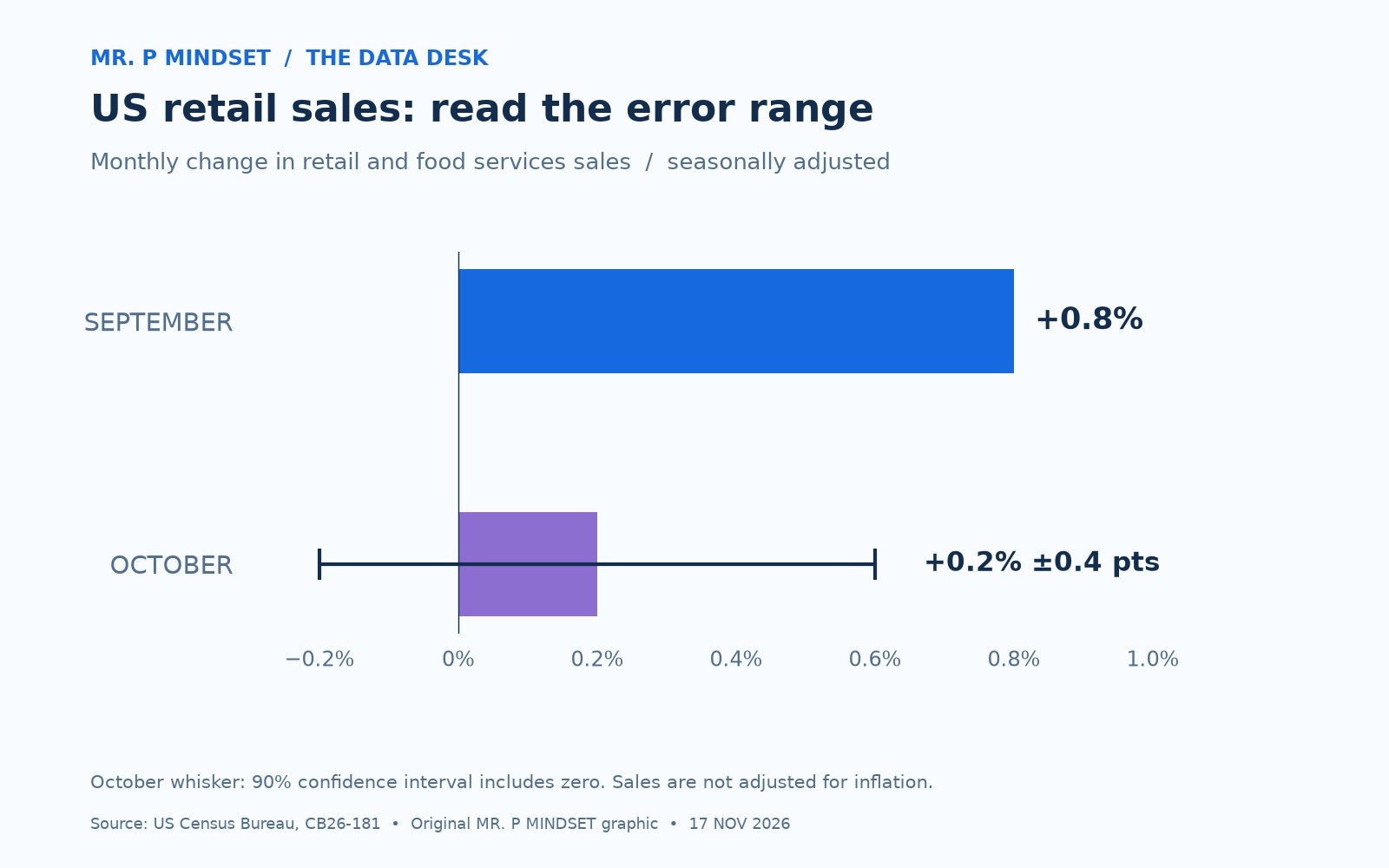
Original graphic explaining us economy figures or scenarios in this article; based on the linked primary source. Educational illustration, not a live market display. Graphic: MR. P MINDSET. Data/scenarios: linked primary release. Original chart drawn from the cited release; no third-party photograph used. October US retail sales rose an estimated 0.2%. The error range and the absence of an inflation adjustment matter as much as the headline.
Key takeaways
- October retail and food services sales were estimated at $748.2 billion.
- The 0.2% monthly estimate carries a ±0.4 percentage-point margin of error.
- These sales figures measure dollars spent, without adjusting for price changes.
The new report
The Census Bureau’s November 17 advance report estimates October US retail and food services sales at $748.2 billion. The monthly change was 0.2%, following September’s unrevised 0.8% gain. Associated Press separately reported the slower monthly spending pace.
The uncertainty belongs in the headline
Census marks October’s monthly estimate with an asterisk: its 90% confidence interval includes zero. The agency says the evidence is insufficient to establish that the actual monthly change differs from zero. That does not mean sales were exactly unchanged. It means this survey cannot confidently distinguish this small estimated movement from no change.
Spending is different from buying more
The release adjusts for seasonal patterns and calendar differences, but not price changes. A larger receipt can reflect higher prices, more purchases, or a different mixture of products. Readers should avoid treating a dollar-sales change as an identical change in the physical amount households bought.
Perspective: use three questions
Before drawing a market conclusion, ask what the indicator measures, which comparison period it uses, and how uncertain the estimate is. This is an advance survey that can be revised. It also covers retailers and food services rather than the whole economy. A single release cannot establish the next Federal Reserve decision, every retailer’s profits, or the direction of a portfolio.
Reading the graphic
The chart compares the published September and October monthly estimates. Its October whisker spans −0.2% to +0.6%, calculated from Census’s ±0.4-point margin. It is an uncertainty interval around an estimate, not a forecast band. The shorter October bar should be read alongside that interval.
Key terms
Inflation: An increase in a broad measure of prices over time; different indexes cover different baskets.
Economic indicator: A statistic describing a defined aspect of economic activity, with its own coverage and revision process.
Continue with the financial glossary and worked market examples.
Sources and reporting dates
Census: October advance retail report — 2026-11-17.
Associated Press: October spending report — 2026-11-17.
Original reporting and educational analysis prepared with AI assistance. Sources checked on November 17, 2026. No live share-price reaction is asserted. Educational information, not personalized investment advice.
Educational disclaimer. MR. P MINDSET provides information and education, not personalized investment, financial, trading, legal or tax advice. Nothing here recommends buying, selling or holding a security. Investing and trading involve risk, including loss of capital. Past performance does not guarantee future results.
November 17, 2026 -

A November 13 notice from the US District Court for the Southern District of New York said a widespread Microsoft outage the previous day had interfered with sending and receiving email. Reuters subsequently reported on November 14 that Microsoft said services had fully recovered. Those dates distinguish documented disruption from the later recovery statement.
The distinction matters when writing about technology reliability. A system provider may announce restored service, while an organization still needs to check delayed communications or work interrupted during the incident. That is an operational possibility, not a claim that a particular customer still has an unresolved problem.
The court's notice provides a concrete example of why email availability can matter beyond convenience. It documented a communication problem; it did not establish the outcome of any individual legal case. Readers should not infer a changed deadline or procedural right from this financial-news article.
For investors, the event raises questions about resilience, customer support and dependence on shared infrastructure. Answering those questions requires evidence such as subsequent incident reports and company disclosures. The outage alone does not establish a specific revenue loss, a successful cyberattack or the cause of an unrelated stock move.
This article is a retrospective report, not a live service-status alert. It does not tell readers that Outlook or Teams remains unavailable on Monday. Organizations in the United States, Canada, England and the Caribbean should consult their current provider status and their own relevant instructions.
Educational information, not personalized investment advice. Investing involves risk.
Sources
Primary source: official announcement or regulatory record
Independent reporting cited in the original article
Frequently asked questions
Does this article say Microsoft services remain unavailable?
No. It reports a November 12 disruption and Reuters’ November 14 account of Microsoft’s recovery statement. It is a retrospective report.
November 16, 2026Does the court notice change an individual legal deadline?
This article establishes no such change. The notice documents an email problem; individual procedural questions require the court’s current instructions.
-

The FDA announced approval of Gazyva, also called obinutuzumab, for adults with primary membranous nephropathy who are at risk of disease progression, to induce remission of proteinuria. FactSet StreetAccount separately reported the decision on November 13. The FDA calls it the first drug approved specifically for adults with this condition.
The disease can damage the kidney's filtering structures and allow protein to leak into urine. That helps explain why a trial might measure remission of proteinuria rather than use a broad phrase such as complete recovery. Readers should keep the exact outcome being measured separate from a claim that every aspect of a disease has disappeared.
The FDA described a randomized study comparing Gazyva with tacrolimus over a 104-week main study period. The approval applies to the population and use described in the label. It should not be extended to all kidney conditions or treated as evidence that the same treatment fits every patient.
Safety is part of the announcement. The label carries boxed warnings concerning hepatitis B reactivation and progressive multifocal leukoencephalopathy, a serious brain infection. This article does not provide treatment selection or dosing advice; the full prescribing information and a qualified treating professional are necessary for individual decisions.
For a reader following healthcare businesses, regulatory approval is one milestone. Insurance coverage, access, prescribing and future revenue are separate questions that this announcement does not settle. A US decision also does not establish authorization or reimbursement in Canada, England or Caribbean countries. This is a dated regulatory report, not a forecast for a healthcare stock.
Educational information, not personalized investment advice. Investing involves risk.
Sources
Primary source: official announcement or regulatory record
Independent reporting cited in the original article
Frequently asked questions
Which use of Gazyva was approved?
The FDA describes adults with primary membranous nephropathy who are at risk of disease progression, with the aim of inducing remission of proteinuria.
November 16, 2026Does the approval cover every kidney condition?
No. The indication is specific, and the prescribing information includes serious safety warnings. Individual treatment decisions require a qualified clinician.
-
FDA records list November 13 as the approval date for Klygefa, or gefurulimab, from Alexion. Its prescribing information identifies a use in adults with generalized myasthenia gravis who are anti-acetylcholine receptor antibody positive. FactSet StreetAccount separately reported the approval and its serious-infection warning.
AstraZeneca confirmed the US approval in a November 16 announcement. The FDA approval history records the regulatory action on November 13. Those dates refer to different records, rather than conflicting claims about the announcement date.
The antibody condition is not a minor footnote. A regulatory indication identifies the group for whom a medicine is approved; shortening it to a treatment for every patient with a broadly named disease could mislead readers. The approval record and the prescribing information answer related but different questions about the product.
The FDA label carries a boxed warning for serious meningococcal infections and describes a restricted risk-management program. This article does not turn that warning into personal clinical instructions. The complete label and a treating professional are needed for decisions about suitability, monitoring and other medicines.
For beginners examining drug-company announcements, it helps to use separate columns for authorization, safety and business results. The first records the regulator's decision. The second covers conditions and risks. The third needs later evidence about availability, coverage and actual commercial performance. A positive decision in the first column does not fill in the other two.
This is a report of a US regulatory action. It does not establish that the product has identical approvals, access rules or reimbursement elsewhere. No drug price, sales forecast or current share-price reaction is asserted.
Educational information, not personalized investment advice. Investing involves risk.
Sources
Primary source: official announcement or regulatory record
Independent reporting cited in the original article
Current FDA prescribing information
AstraZeneca US approval announcement, November 16
Frequently asked questions
Who is included in Klygefa’s US indication?
Its FDA label identifies adults with generalized myasthenia gravis who are anti-acetylcholine receptor antibody positive.
November 16, 2026What prominent safety warning accompanies Klygefa?
The prescribing information carries a boxed warning about serious meningococcal infections and describes a restricted risk-management program. This article gives no individual treatment advice.
-

The FDA approved a new treatment sequence on November 13 for certain adults with muscle-invasive bladder cancer. Durvalumab, sold as Imfinzi, is combined with enfortumab vedotin-ejfv before surgery, followed by durvalumab alone after radical cystectomy. The indication covers patients ineligible for, or refusing, cisplatin-based chemotherapy. OncLive independently reported the same decision.
The order of treatment is important. Neoadjuvant means treatment before the main operation; adjuvant means treatment afterward. Omitting the timing would leave a reader with an incomplete description of what was approved. The announcement is not simply permission to use two medicines interchangeably at any stage of disease.
The FDA based the decision on the VOLGA trial and reported improvements in event-free and overall survival for the studied combination compared with surgery alone. A trial comparison describes outcomes across groups. It does not guarantee the same result for every person or permit comparisons with unrelated studies without checking their designs.
The regulator also lists warnings concerning immune-mediated reactions and other serious risks. The existence of an approval should therefore be read together with the full label, not as an assurance that a medicine is suitable for everyone. This article offers no treatment choice, dosing instructions or advice to delay clinical care.
For healthcare-sector readers, a new indication may broaden a medicine's permitted use, but future prescribing, coverage and revenue still require evidence. The decision is from the United States. It does not by itself establish authorization in Canada, England or a Caribbean jurisdiction, and it establishes no stock-price response.
Educational information, not personalized investment advice. Investing involves risk.
Sources
Primary source: official announcement or regulatory record
Independent reporting cited in the original article
Frequently asked questions
Why does treatment timing matter in this approval?
The approved sequence combines durvalumab and enfortumab vedotin-ejfv before surgery, followed by durvalumab alone after radical cystectomy, for the specified eligible patients.
November 16, 2026Does the trial guarantee an individual patient’s outcome?
No. Group results cannot guarantee a particular outcome. The full prescribing information and clinical advice remain necessary.
-
The FDA approved Sunharbo, or asundexian, on November 9 as the first factor XIa inhibitor for a specified secondary stroke-prevention use. The decision covers certain adults following a recent non-cardioembolic ischemic stroke or a high-risk transient ischemic attack, in combination with antiplatelet therapy. Pharmacy Times independently reported the approval.
Secondary prevention means trying to reduce the risk of another event after a qualifying earlier event. It is different from a general claim that a medicine prevents every type of stroke in everyone. The FDA specifically states that Sunharbo is not approved for stroke prevention in patients with atrial fibrillation.
The regulator based the decision on the OCEANIC-STROKE trial. Its report describes a benefit relative to a comparator in the studied population, while also highlighting bleeding risks, including gastrointestinal bleeding and additional concerns in older patients and early treatment. A favorable trial result does not mean the possibility of harm has disappeared.
For healthcare-business readers, a first-in-class approval can be significant without establishing the size of the eventual market. Product availability, insurance coverage, competing treatments and actual use require their own evidence. This article does not estimate sales, prescribe the medicine or rank therapies for a particular person.
The decision concerns the United States. Approval, clinical practice and reimbursement can differ in Canada, England and Caribbean countries. Readers should consult the full current label and an appropriate treating professional for individual medical questions.
Educational information, not personalized investment advice. Investing involves risk.
Sources
Primary source: official announcement or regulatory record
Independent reporting cited in the original article
Frequently asked questions
What does secondary stroke prevention mean here?
It concerns reducing another stroke risk after the qualifying recent non-cardioembolic ischemic stroke or high-risk transient ischemic attack, alongside antiplatelet therapy.
November 16, 2026Is Sunharbo approved for stroke prevention in atrial fibrillation?
The FDA states it is not approved for that use. Its specified indication and bleeding risks should be read in the current label.
-

Meta describes an early-November expansion of AI age estimation intended to place more Instagram users in Teen Account protections, including users who supplied an adult birth date. Engadget separately reported the expansion. The announcement concerns how the company applies safeguards; it is not a published measurement of perfect accuracy.
Meta says Teen Accounts include limits concerning contact, content and time on its apps. It also discusses continued deployment on Facebook and a planned launch of similar technology on Threads. A current feature on one platform should not be described as already operating everywhere the company intends to take it.
The business issue is the relationship between product design, user trust and the cost of meeting safety obligations. Those factors can matter to a technology company without an article inventing a dollar value for them. This report makes no claim about new advertising revenue, compliance savings or the outcome of any particular account decision.
A beginner can evaluate the announcement by separating three questions: what the company says it is rolling out, whether a particular account has received it, and how well the system performs. The first can be checked against a release. The other two require different evidence. A claim about deployment cannot substitute for an accuracy study.
Readers in the United States, Canada, England and Caribbean jurisdictions should check the current platform documentation and applicable local rules separately. This article does not instruct families to change accounts or share identity documents. It stays with the confirmed expansion and leaves claims about detection methods, error rates and individual outcomes out of the report.
Educational information, not personalized investment advice. Investing involves risk.
Sources
Primary source: official announcement or regulatory record
Independent reporting cited in the original article
Frequently asked questions
What is Meta expanding?
Meta describes expanding AI age estimation to place more Instagram users in Teen Account protections, including users who entered an adult birthday.
November 16, 2026Does a rollout announcement prove the system is perfectly accurate?
No. Deployment, an individual account’s status and independently measured accuracy are separate questions.
-

The Energy Information Administration reported US commercial crude-oil stocks of 414.4 million barrels for the week ended November 6, a published weekly increase of 4.7 million barrels. The Wall Street Journal separately reported the same figures. These describe a completed reporting week, not inventories measured on Monday morning.
The word commercial matters. EIA lists the Strategic Petroleum Reserve separately, so adding or comparing the categories without checking their definitions can create a misleading total. The published table also notes that rounding can affect how displayed components add together. Readers should use the reported change rather than assume all rounded totals reconcile perfectly.
An inventory is oil held in storage at a point in time. Production, imports, exports and refinery activity are flows over a period. A stock increase can occur through several combinations of those flows. It should not automatically be described as proof that every household used less fuel or that all producers earned more money.
For beginners following energy companies, the report offers context rather than a complete business assessment. A producer, refiner and fuel retailer face different exposures. The same national figure cannot establish the profit or share-price performance of each business.
This article supplies no live oil price or Monday market reaction. It also does not assume that US inventories measure Canadian or Caribbean stocks, or storage in England.
Educational information, not personalized investment advice. Investing involves risk.
Sources
Primary source: official announcement or regulatory record
Independent reporting cited in the original article
Frequently asked questions
Do the crude-stock figures describe Monday morning?
No. They describe the reporting week ended November 6, 2026. The reported commercial total is 414.4 million barrels, with a published weekly increase of 4.7 million barrels.
November 16, 2026Is the Strategic Petroleum Reserve part of that commercial figure?
No. EIA reports the Strategic Petroleum Reserve separately. Inventory data also differ from oil prices and company earnings.
-

The International Energy Agency's November 13 Oil Market Report projects a return to global oil surplus in the fourth quarter as Gulf exports recover faster than demand. Reuters independently reported the changed balance assessment. The conclusion is a forecast built from the agency's information and assumptions, not a guarantee that disruptions are over.
The report says global oil supply rose by 2.3 million barrels a day in October to 105.4 million barrels a day. It separately discusses later supply-and-demand balances. A monthly observation, a quarterly forecast and a forecast for next year should not be placed in the same column as though they were measurements of one period.
For beginners, surplus means that estimated supply exceeds estimated demand over the period being discussed. It does not mean every location has abundant fuel or that every product is equally available. Crude oil, diesel and other refined products move through different parts of the supply chain.
The agency continues to identify shipping and infrastructure risks. That uncertainty limits how confidently a forecast can be carried into an investment claim. A producer's earnings also depend on its own costs, contracts and operations; a global balance estimate cannot determine a particular company's result.
This article draws on the publicly readable report highlights and separate Reuters coverage. It supplies no current crude-price quotation, shipping prediction or claim that the forecast has already occurred. Readers in the United States, Canada, England and the Caribbean should distinguish global market context from local fuel taxes, distribution costs and retail prices.
Educational information, not personalized investment advice. Investing involves risk.
Sources
Primary source: official announcement or regulatory record
Independent reporting cited in the original article
Frequently asked questions
Is the IEA’s surplus outlook a guaranteed result?
No. It is a forecast based on the agency’s assumptions and information. Shipping and infrastructure risks remain relevant.
November 16, 2026What does a global oil surplus mean?
It means estimated supply exceeds estimated demand over the period discussed. It does not establish equal fuel availability in every location.

